



Holocaust Memorial Day 27th January Assembly
19 Feb 2023
Holocaust Memorial Day Trust (HMDT) encourages remembrance in a world scarred by genocide. We promote and support Holocaust Memorial Day (HMD) – the international day on 27 January to remember the six million Jews murdered during the Holocaust, alongside the millions of other people killed under Nazi persecution of other groups and during more recent genocides in Cambodia, Rwanda, Bosnia and Darfur.
27 January marks the anniversary of the liberation of Auschwitz-Birkenau, the largest Nazi death camp.
The Holocaust threatened the fabric of civilisation, and genocide must still be resisted every day. Our world often feels fragile and vulnerable and we cannot be complacent. Even in the UK, prejudice and the language of hatred must be challenged by us all.
HMD is for everyone. Each year across the UK, thousands of people come together to learn more about the past and take action to create a safer future. We know they learn more, empathise more and do more.
Together we bear witness for those who endured genocide, and honour the survivors and all those whose lives were changed beyond recognition.
Until the end of its existence, the Auschwitz camp was above all a place of extermination. In other camps, the death rate was lowered from 1943 in an effort to conserve the labor force. In Auschwitz, however, where new transports, mostly of Jews, arrived continuously and kept the camp supplied with laborers, human life never had any great significance.
Historians estimate that around 1,1 million people perished in Auschwitz during the less than 5 years of its existence. The majority, around 1 million people, were Jews. The second most numerous group, from 70 to 75 thousand, was the Poles, and the third most numerous, about 20 thousand, the Gypsies. About 15 thousand Soviet POWs and 10 to 15 thousand prisoners of other ethnic backgrounds (including Czechs, Byelorussians, Yugoslavians, French, Germans, and Austrians) also died there. In view of the role that it played in the realization of the Nazi extermination plans, Auschwitz is known around the world as a symbol of Nazi genocide, and especially of the destruction of the Jews.
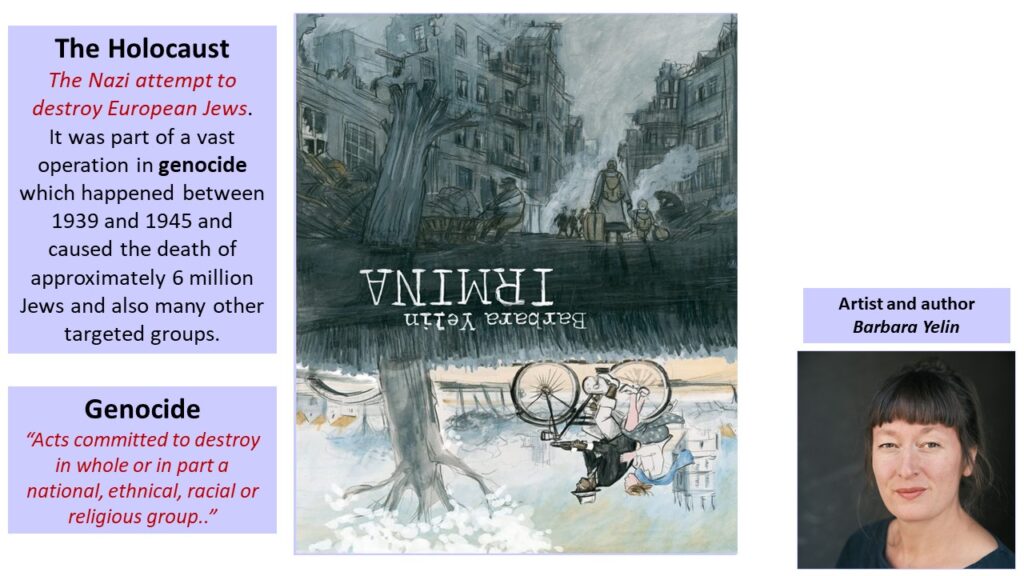
Graphic novel author named Barbara Yelin (author of Irmina) stumbled across a box around 15 years ago in her mothers flat which contained a number of things belonging to her late grandmother who passed away 25 years ago. The things contained in the box were a collection of documents and diaries containing details of her Grandmothers life but also details of her Grandfather who she had never known. Barbara’s Grandmother had not told her much about her life before the second world war and during the second world war, however the contents of the box she found revealed that her Grandmother was actually a silent bystander in Germany during the period of the Holocaust.
In the mid-1930s, Irmina, an ambitious young German, moves to London. At a cocktail party, she meets Howard Green, one of the first black students at Oxford, who, like Irmina, is working towards an independent existence. However, their relationship comes to an abrupt end when Irmina, constrained by the political situation in Hitler’s Germany, is forced to return home. As war approaches and her contact with Howard is broken, it becomes clear to Irmina that prosperity will only be possible through the betrayal of her ideals. In the award-winning Irmina, Barbara Yelin presents a troubling drama about the tension between integrity and social advancement. Based on a true story, this moving and perceptive graphic novel perfectly conjures the oppressive atmosphere of wartime Germany, reflecting with compassion and intelligence on the complicity that results from the choice, conscious or otherwise, to look away.
“A comic of substance, real feeling and expression” Paul Gravett, Editor of 1001 Comics to Read
The United Nations Convention of 1948 defines the crime of genocide as “acts committed to destroy in whole or in part a national, ethnical, racial or religious group as such”. Genocide literally means the annihilation of a race.
Irmina explores the life of an ordinary person, it is based on the life of Barbara’s Grandmother. It brings together the contents of the documents and diary entries Barbara found in her Grandmothers memory box. It reveals that her Grandmother was a bystander during the Holocaust and highlights to us that ordinary people were involved in the horrors of the holocaust not just the evil dictators we think of when think of who was to blame for this horrible event in history. It challenges us to consider how being a bystander can be considered just as bad as being a perpetrator because it allows the perpetrator to continue their abuse without being challenged. Perpetrators often thrive through the silent support of bystanders and this should challenge us all to seek to become upstanders against prejudice and injustice in our world today.
The main character is named Irmina, a young German women who is 19 years old. Irmina moves in 1934 from Stuttgart to England because she does not want to stay in Germany. In England as a student she meets and falls in love with a student from Barbados. Eventually though in 1936 she decides to return to Nazi Germany and there we begin to see her changing as she marries a Nazi architect and becomes a bystander and turns into the someone who profits from the Nazi regime and she finds herself turning a blind eye to the terrible persecution of the Jews.
Genocide is facilitated by ordinary people. Ordinary people turn a blind eye, believe propaganda, join regimes. And those who are persecuted, oppressed and murdered in genocide aren’t persecuted because of crimes they’ve committed – they are persecuted simply because they are ordinary people who belong to a particular group (eg, Roma, Jewish community, Tutsi).
Ordinary people were involved in all aspects of the Holocaust, Nazi persecution of other groups, and in the genocides that took place in Cambodia, Rwanda, Bosnia and Darfur. Ordinary people were perpetrators, bystanders, rescuers, witnesses – and ordinary people were victims.
In every genocide, those targeted faced limited choices – ‘choiceless choices’ (Lawrence Langer) but in every genocide the perpetrators have choices, ordinary people have choices.
Our theme this year, though, highlights the ordinary people who let genocide happen, the ordinary people who actively perpetrated genocide, and the ordinary people who were persecuted.
Our theme will also prompt us to consider how ordinary people, such as ourselves, can perhaps play a bigger part than we might imagine in challenging prejudice today.
In order to explore the theme of Ordinary people, we will look at some specific categories (perpetrators, bystanders, rescuers). It is important to note that people do not always fall neatly into one of these categories, and that within categories, within sectors, jobs and responsibilities there were a range of responses to what was going on around them.
Kristallnacht: the Night of Broken Glass, also called the November pogrom(s) a pogrom against Jews carried out by the Nazi Party’s Sturmabteilung (SA) paramilitary and Schutzstaffel (SS) paramilitary forces: Jewish homes, hospitals and schools were ransacked as attackers demolished buildings with sledgehammers.[5] Rioters destroyed 267 synagogues throughout Germany, Austria and the Sudetenland.[6] Over 7,000 Jewish businesses were damaged or destroyed,[7][8] and 30,000 Jewish men were arrested and incarcerated in concentration camps.
Not all upstanders began as upstanders. They made mistakes and then learned from them, becoming upstanders. Consider Martin Niemoller’s journey from bystander, to upstander, to poem writer.
Please also embed this second video on the same slide if possible: